
Antivirus vs EDR: What Businesses Need to Know
Antivirus and EDR are not the same. Learn how EDR improves endpoint security, why old antivirus is no longer enough, and when businesses should consider SentinelOne.
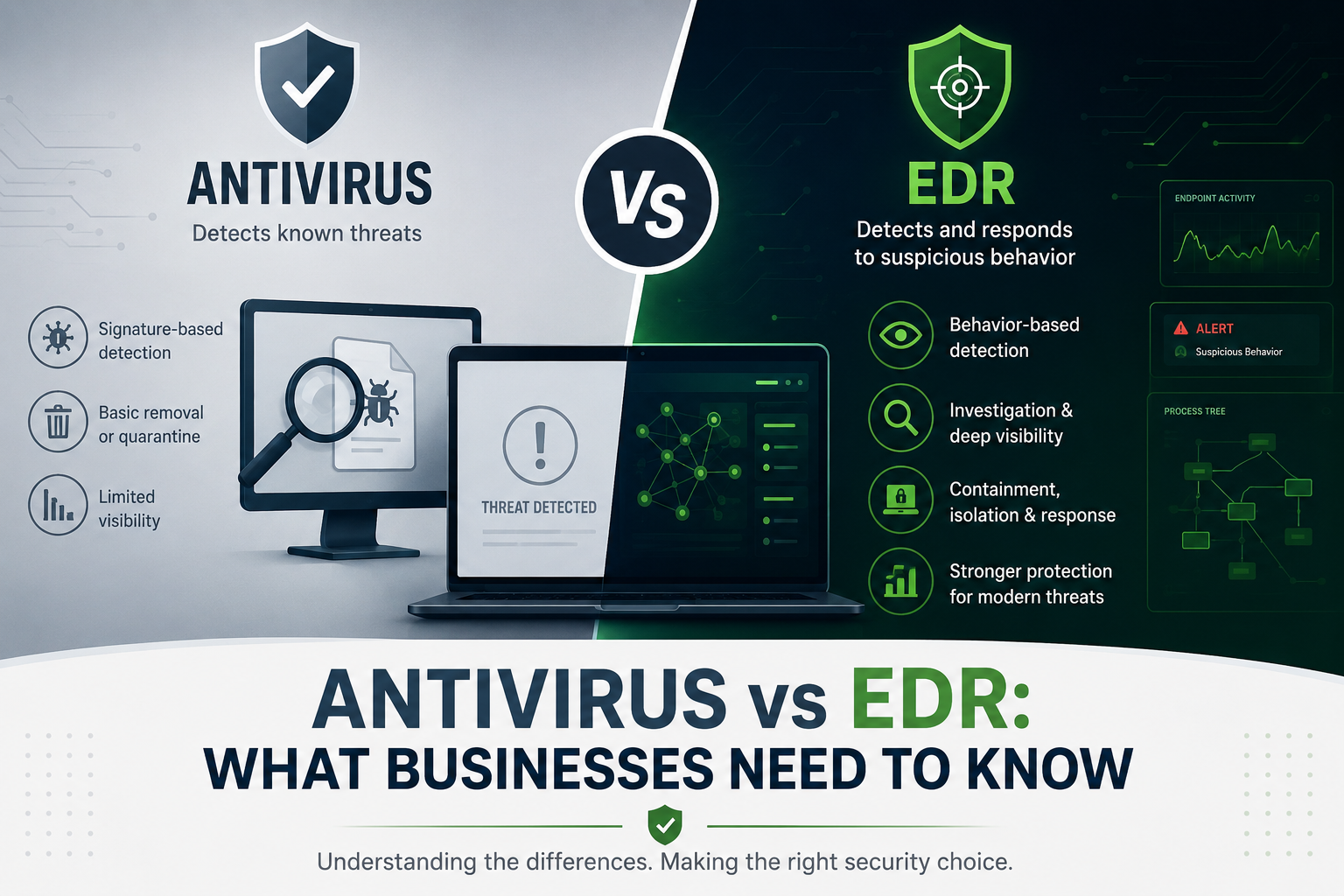
Antivirus and EDR are both used to protect business devices, but they are not the same thing.
Traditional antivirus mainly focuses on detecting known malicious files.
EDR, which stands for Endpoint Detection and Response, focuses on detecting suspicious behavior, investigating endpoint activity, and responding to threats before they spread.
For modern businesses, that difference is critical.
The question is no longer “Do we have antivirus?”
The better question is “Can we detect and respond when an endpoint starts behaving suspiciously?”
The Simple Difference
Traditional antivirus asks:
“Is this file known to be dangerous?”
EDR asks:
“Is this endpoint behaving in a dangerous way?”
That is the core difference.
Old antivirus is useful when the threat is already known, cataloged, and easy to identify. But many modern attacks are designed to avoid that model. They may use legitimate tools, stolen credentials, scripts, or unusual behavior that does not look like a classic virus file.
EDR gives the business a deeper view into what is happening on laptops, desktops, and servers.
What Traditional Antivirus Does Well
Antivirus can still be useful.
It can help block known malware, scan files, detect suspicious downloads, and provide a basic layer of endpoint protection.
For a very small business with limited risk, basic antivirus may feel like enough.
But that confidence can be misleading.
Antivirus is usually reactive. It is strongest when the threat is already recognized. The problem is that attackers now use techniques that do not always depend on obvious malware files.
A modern cyber incident may involve:
A fake invoice
A stolen Microsoft 365 password
A malicious script
A remote access tool
Suspicious file encryption
A compromised employee laptop
Lateral movement between systems
In these cases, the behavior matters as much as the file.
What EDR Does Differently
EDR monitors endpoint behavior and provides detection and response capabilities.
A strong EDR solution can help identify:
Ransomware-like activity
Suspicious PowerShell usage
Unusual process behavior
Unknown network connections
Attempts to disable security tools
Abnormal file changes
Possible compromise on a business device
The value is not only detection. It is response.
With EDR, the business can investigate alerts, isolate devices, stop processes, and understand what happened.
That is why EDR is a better fit for businesses that rely on cloud systems, remote work, customer data, and operational continuity.
Why Old Antivirus Is Not Enough for Modern Businesses
Old antivirus was built for a simpler threat model.
A bad file enters the computer. The antivirus recognizes it. The file is blocked or removed.
Modern attacks are more complex.
Attackers may use tools that already exist inside Windows. They may use stolen passwords. They may target cloud accounts. They may run scripts that look normal until they are connected to a wider chain of activity.
This is why businesses need endpoint security that can understand behavior.
The issue is not only whether a file is bad.
The issue is whether the endpoint is doing something that creates business risk.
SentinelOne as an EDR Solution
SentinelOne is a modern endpoint protection and EDR platform. It is designed to help businesses prevent, detect, respond to, and recover from endpoint threats.
For businesses looking to move beyond basic antivirus, SentinelOne is a strong direction because it gives deeper endpoint visibility and response capabilities.
At 1iT, SentinelOne can be provided as a license and as part of a managed service.
That means the business is not only buying software. It can also get help with:
Deployment
Policy configuration
Endpoint coverage
Alert review
Threat response
Device isolation
Ransomware protection planning
Ongoing improvement
Learn more here:
SentinelOne EDR and endpoint protection
Antivirus vs EDR Comparison
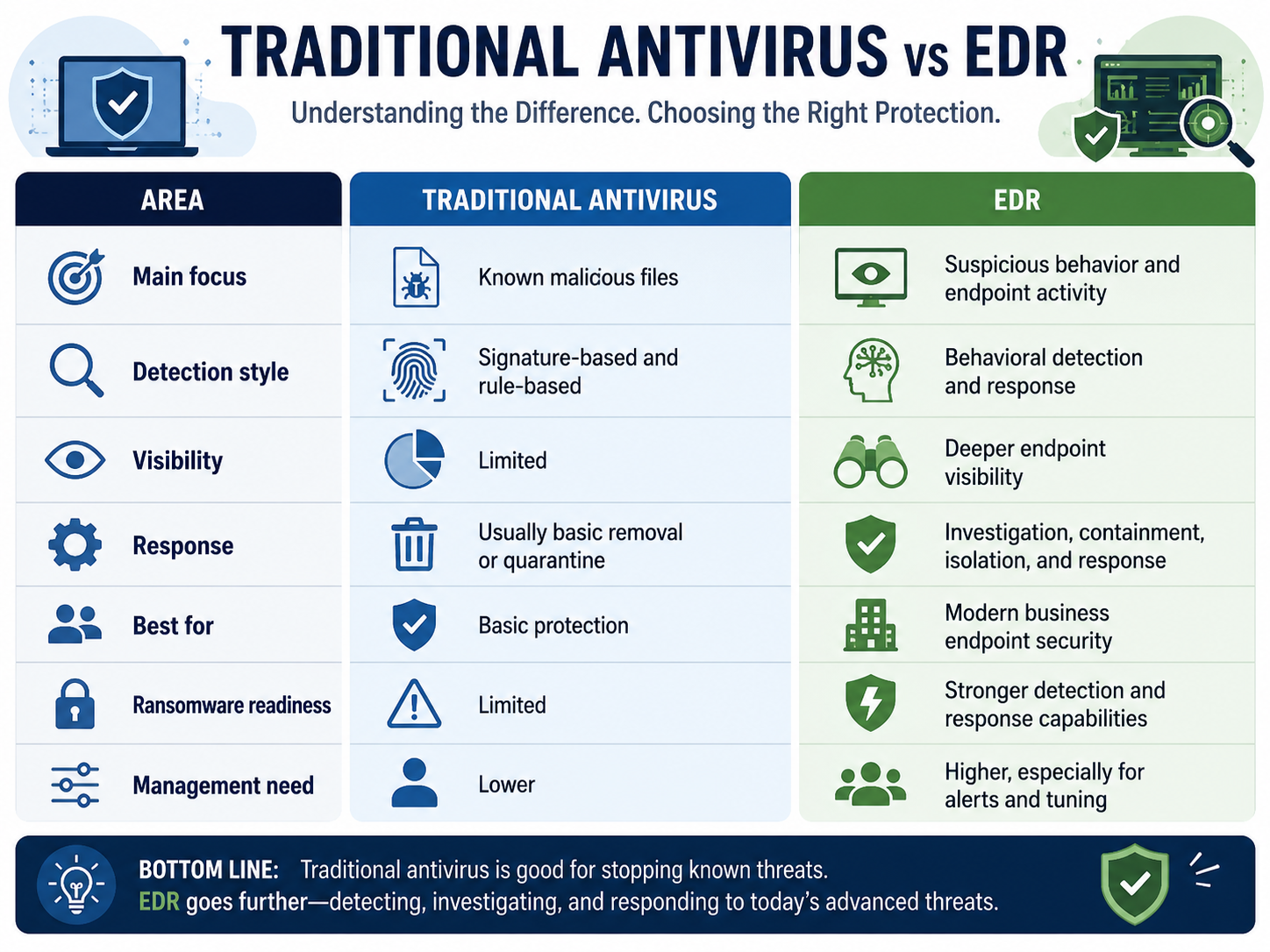
The important point is this:
EDR is stronger, but it should be managed properly.
An unmanaged EDR tool can still create missed alerts, noisy dashboards, and weak response processes.
When Should a Business Move from Antivirus to EDR?
A business should seriously consider EDR if it has:
More than a few business endpoints
Remote or hybrid employees
Microsoft 365 or cloud-based work
Customer data
Financial data
Shared files
Compliance concerns
Operational systems that cannot afford downtime
A history of phishing attempts
Concern about ransomware
For many small and mid-sized businesses, EDR is no longer excessive. It is becoming the reasonable baseline.
Why EDR Should Be Part of a Wider Cybersecurity Strategy
EDR protects endpoints, but cybersecurity is broader than endpoint protection.
A complete security approach should also consider:
Email security
Microsoft 365 security
Identity and MFA
Cloud backup
Firewall and network protection
User awareness
Incident response procedures
That is why EDR should connect to a wider cybersecurity plan.
Read more here:
Cybersecurity services for business
Managed EDR vs Buying a Tool
Buying an EDR tool is not the same as having a managed EDR service.
The tool can generate alerts.
The service makes sure someone understands those alerts and acts on them.
For small and mid-sized businesses, this is often the better model. The business gets strong endpoint security without forcing internal IT to operate like a security operations center.
A managed EDR service can help with:
Correct configuration
Alert triage
Threat response
Device isolation
Reporting
Continuous tuning
That is where the real business value is.
Final Recommendation
If your business still relies only on old antivirus, it is time to reassess your endpoint security.
Antivirus may still block known threats, but it does not provide the same level of visibility, detection, and response that modern EDR provides.
For businesses that care about ransomware protection, endpoint visibility, and fast response, EDR is the better direction.
And for companies that want the protection without managing the complexity internally, managed SentinelOne EDR is the practical next step.
Related posts
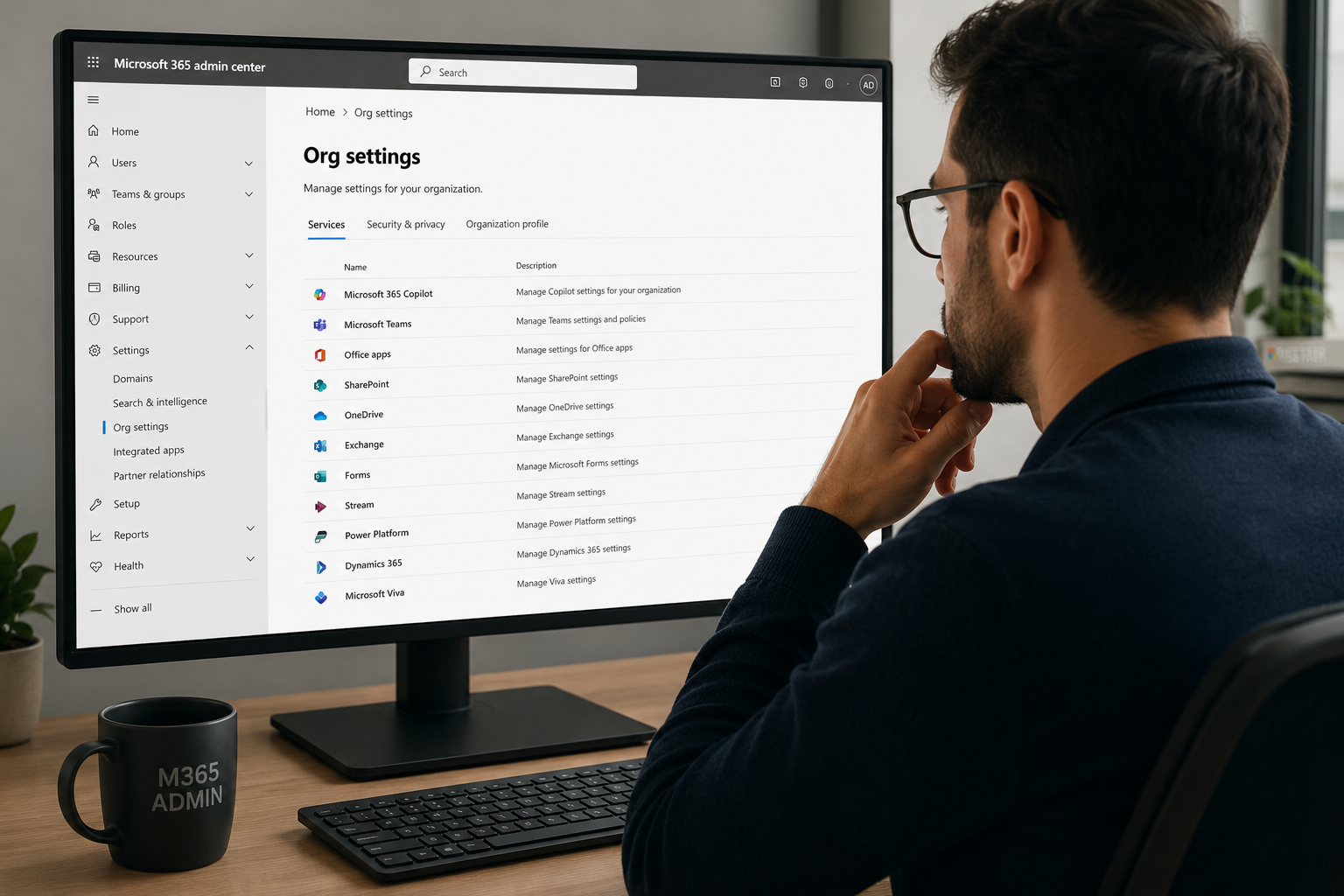
Microsoft 365 Security: 10 Settings Every Israeli Business Must Configure in 2026
Phishing, account takeover and Business Email Compromise are the #1 threat to Israeli businesses. A practical guide - 10 Microsoft 365 security settings that block most attacks before they start.
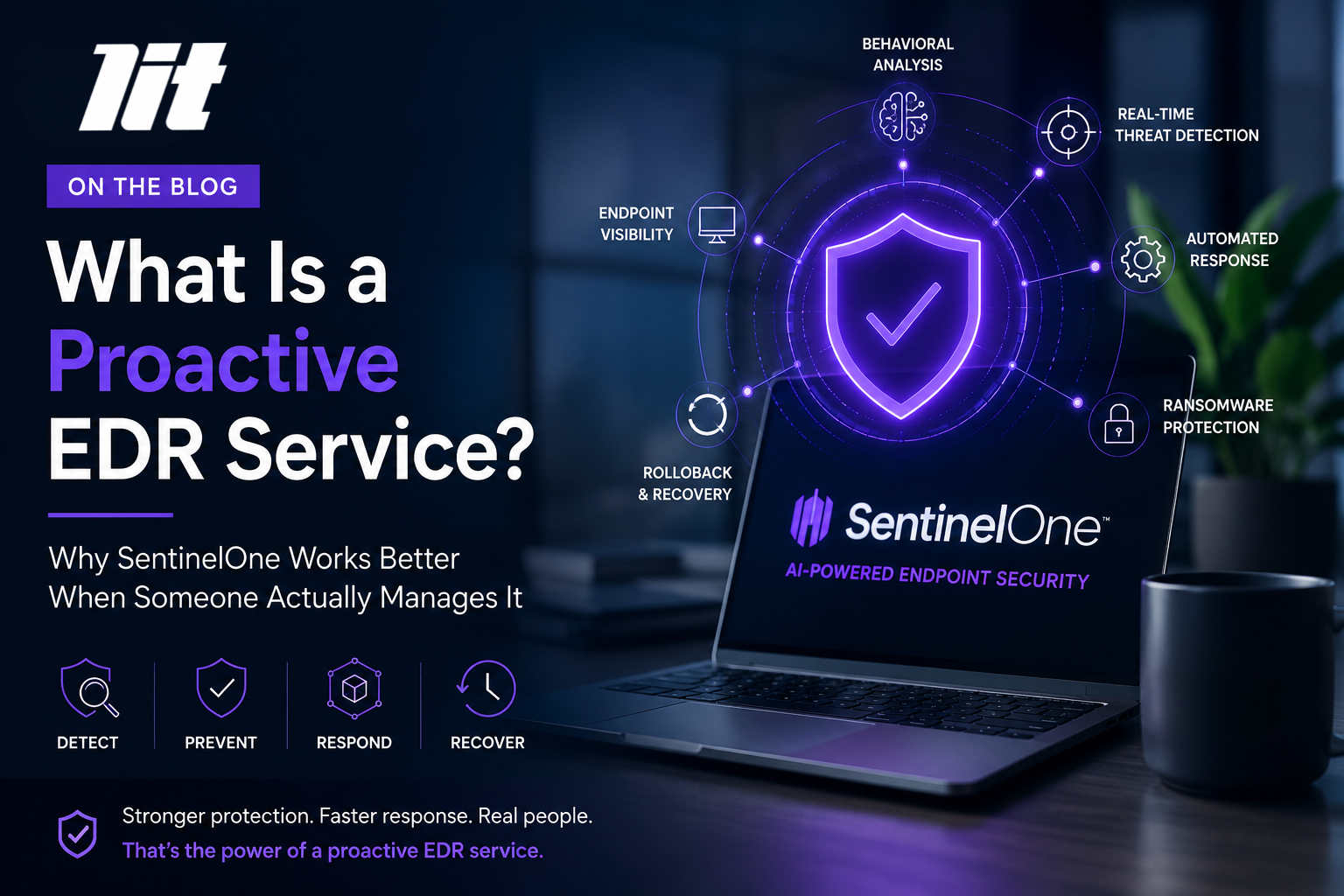
What Is a Proactive EDR Service? Why SentinelOne Works When It's managed
A proactive EDR service is not just endpoint security software. It is a managed security approach that combines an advanced EDR solution like SentinelOne with human monitoring, policy tuning, alert review, threat response, and ongoing improvement.
How Cloud Backup Helps After Ransomware
Cloud backup helps businesses recover after ransomware by restoring clean data, reducing downtime, and supporting business continuity when files are encrypted or deleted.